
Tanzania Key Population Bio-Behavioral Survey
General-population surveys are essential, but they are not designed to answer every HIV question. Some communities experience different exposure patterns, service barriers and network structures and may be too small or too poorly represented to be described accurately through conventional household sampling. Tanzania's Key Population Bio-Behavioral Survey was designed to create more specific evidence while keeping dignity, privacy and community agency central to the research.
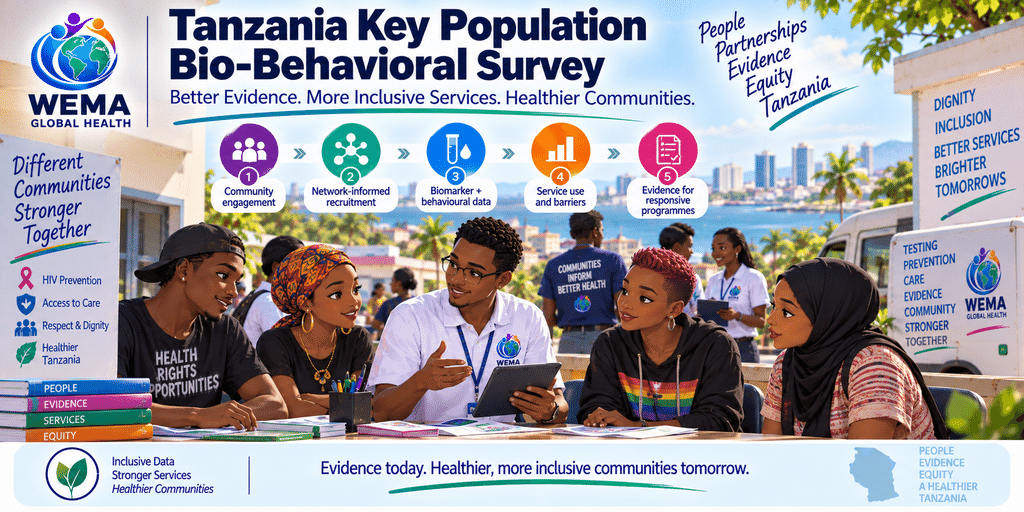
The study focuses on men who have sex with men, women engaged in sex work, people who inject drugs and transgender women. Its purpose is not to define people by risk. It is to understand the conditions under which prevention, testing, treatment and other health services can be more responsive. Biological measures are combined with behavioral information, health-service use and population-size estimation so that prevalence is not interpreted without the service and social context surrounding it.
The project therefore treats visibility as an ethical as well as an epidemiologic task. Better evidence can help programmes allocate resources, design services and monitor whether communities are being reached, but poorly designed research can expose people to stigma or reduce complex lives to a single risk category. The survey uses methods suited to populations not well captured by household frames and integrates community engagement into the research process. Its broader contribution is a model for generating planning evidence without turning surveillance into exposure: make service needs visible, preserve uncertainty where estimates are imprecise and communicate findings in ways that support care rather than stigma.