
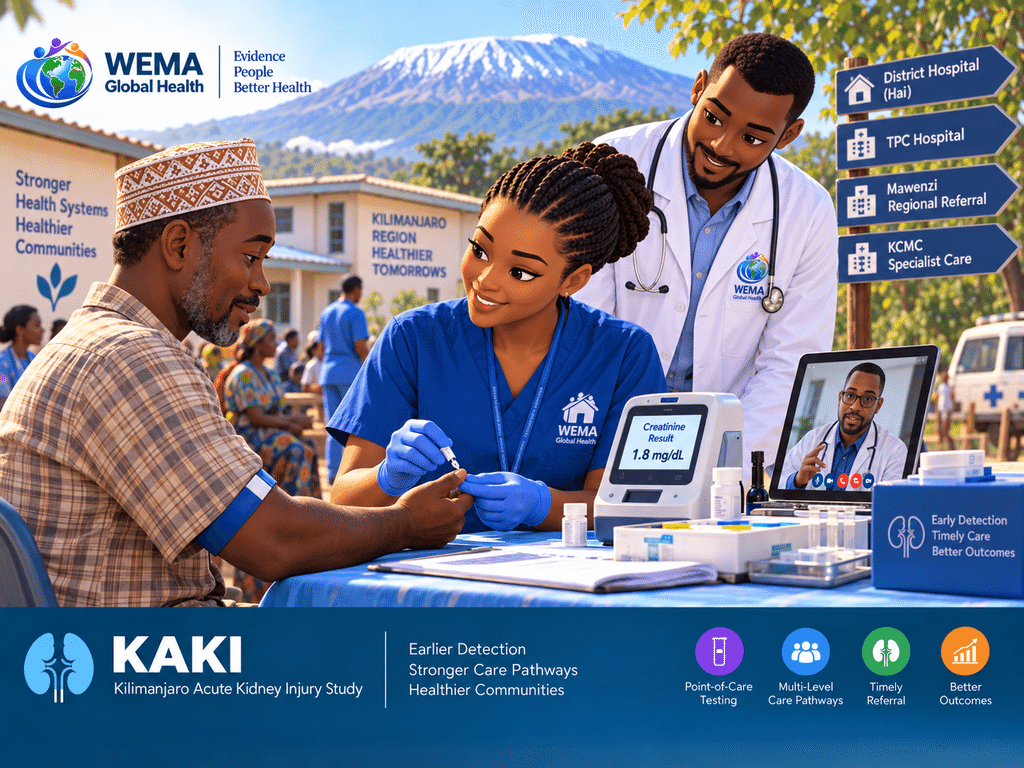
KAKI / Kilimanjaro Acute Kidney Injury Study
KAKI starts from the fact that acute kidney injury can become severe before its seriousness is obvious. A patient may present with another illness, early kidney injury may not produce distinctive symptoms and creatinine testing may not be immediately available. By the time specialist renal care is reached, opportunities to correct reversible causes or prevent further injury may already have narrowed. KAKI asks how recognition and management can be moved earlier in the care pathway.
The project translates the 5R framework - Risk, Recognition, Response, Renal Support and Rehabilitation - into a practical Tanzanian health-system approach. That framework links what happens before a diagnosis with what happens after stabilization. Identifying who is at risk, making kidney injury visible, responding promptly, connecting severe cases to renal expertise and following survivors after discharge are treated as one care architecture rather than separate clinical tasks.
KAKI is therefore both a kidney study and a systems study. Its purpose is not to wait until dialysis becomes the only remaining option. It examines how health-worker knowledge, point-of-care testing, teleconsultation, referral and follow-up can help lower-level and referral facilities act sooner and more consistently. By working across several levels of care in northern Tanzania, the project makes escalation itself part of the research question. The wider goal is to learn whether better organization, earlier information and connected decision support can reduce preventable delay in a condition where time and system readiness matter profoundly.