
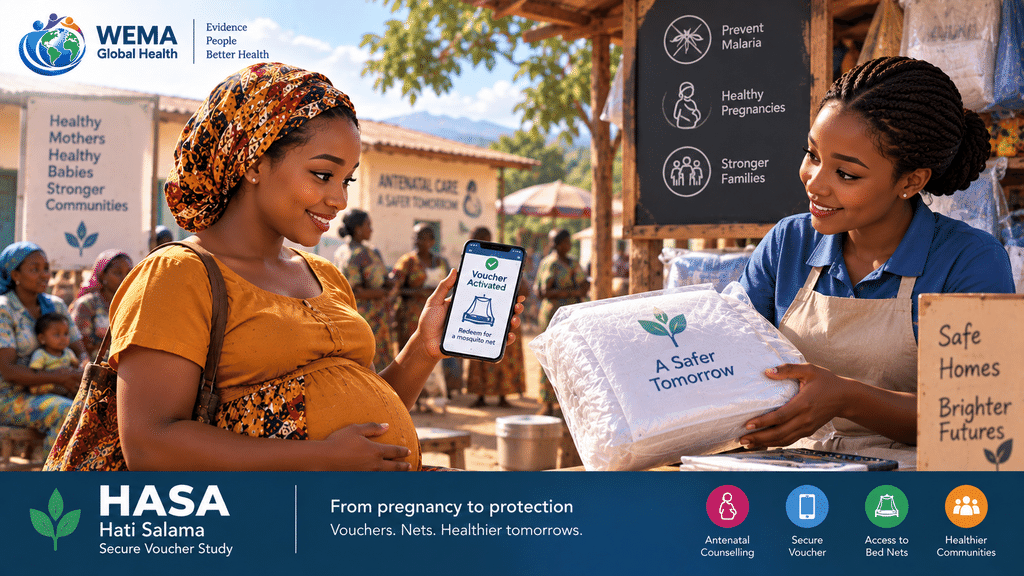
HASA / Hati Salama - Secure Voucher Study
HASA asks what happens in the space between preventive advice and actual access. During antenatal care, a health worker can recommend a long-lasting insecticidal net, but the woman still has to receive clear information, obtain a valid voucher, reach a participating retailer within the required period and find the product in stock. The programme made this sequence visible by linking antenatal services with an electronic voucher, mobile communication and local retail redemption.
The study is important because it separates two questions that are often blended together. Can a digital voucher pathway operate across a large service network? And does adding behaviour-change messaging improve the primary outcome of voucher redemption? HASA showed that an implementation platform can be feasible even when a particular added communication component does not produce a significant comparative benefit.
The project therefore goes beyond malaria prevention. It is a practical study of how health-system handoffs determine whether a recommended intervention reaches the person who needs it. Clinic workflow, phone access, network connectivity, retailer participation, stock, travel, timing and competing events in pregnancy all become part of the intervention environment. By pairing a cluster-randomized trial with process evaluation, HASA turns a simple-looking voucher into a detailed account of access. Its central contribution is the recognition that digital tools do not bypass health systems; they make the dependencies between people, commodities and services easier to see and study.