
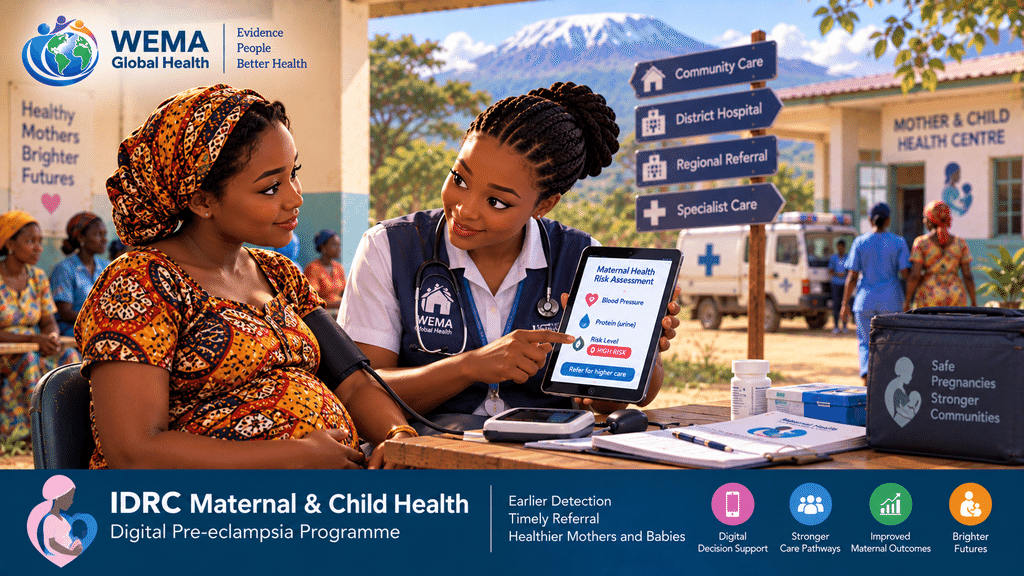
IDRC Maternal & Child Health / Digital Pre-eclampsia Programme
Hypertensive disorders of pregnancy can become dangerous quickly, yet the first warning signs often appear far from specialist obstetric care. A pregnant woman may first be seen in the community or at a lower-level facility, where blood-pressure measurement, recognition of danger signs, communication and referral all need to work reliably. This maternal-health programme explored how digital communication and decision support could strengthen that sequence, with pre-eclampsia providing a clear example of a time-sensitive condition in which delay can rapidly increase risk.
The programme is best understood as a maternal-safety pathway rather than a technology project. Information has to move from the woman and family to a frontline provider, from the provider to an appropriate referral service and then into timely clinical action. Digital tools can support communication and escalation, but they cannot substitute for transport, clinical judgment, referral capacity or trust in the care pathway.
Its broader significance lies in connecting community realities with health-system readiness. Maternal emergencies are shaped by several delays: recognizing that something is wrong, deciding to seek care, reaching an appropriate facility and receiving effective treatment. The project used digital-health thinking to ask how some of those delays might be reduced or made more visible. Within the WEMA portfolio it represents an important legacy line of maternal and child health research: early mobile decision support was used not as an end in itself, but as a way to connect danger-sign recognition with referral, clinical escalation and safer maternal care.