
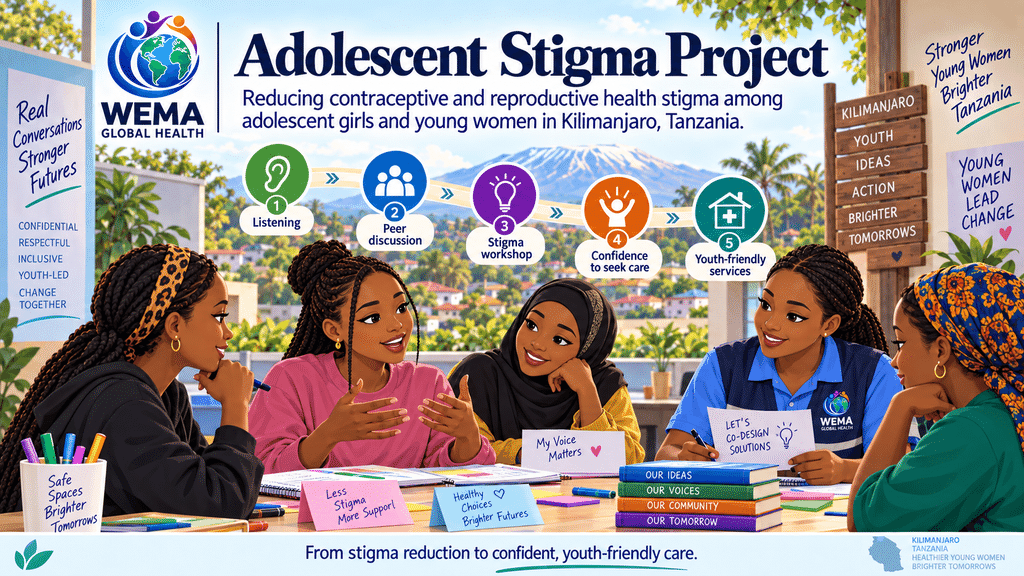
Adolescent Stigma Project
The Adolescent Stigma Project examines a barrier that conventional service-availability measures often miss: the social cost of seeking sexual and reproductive health information or contraception. Adolescents can know that services exist and still avoid them because asking questions, carrying contraception or being seen near a service can expose them to judgement from peers, partners, families, providers or the wider community.
The project works with adolescent girls and young women in Kilimanjaro, Tanzania, and focuses on how stigma is experienced and how a stigma-reduction intervention can be adapted to local realities. Rather than transferring an existing workshop unchanged, the research uses participatory adaptation so that language, scenarios and activities reflect adolescent development, gender norms, peer relationships and the social environments in which young women make decisions.
This makes intervention adaptation part of the science. A programme can be evidence-based in its original setting and still fail if examples feel irrelevant, language feels technical or activities do not match the sources of stigma participants actually encounter. By involving young people and Tanzanian facilitators in the adaptation process, the project tests how a stigma-reduction model can remain conceptually grounded while becoming culturally and developmentally appropriate for adolescent sexual and reproductive health.
By making adaptation visible as scientific work, the project also offers a model for programmes that need to transfer behavioural interventions across age groups, communities or cultural settings.