
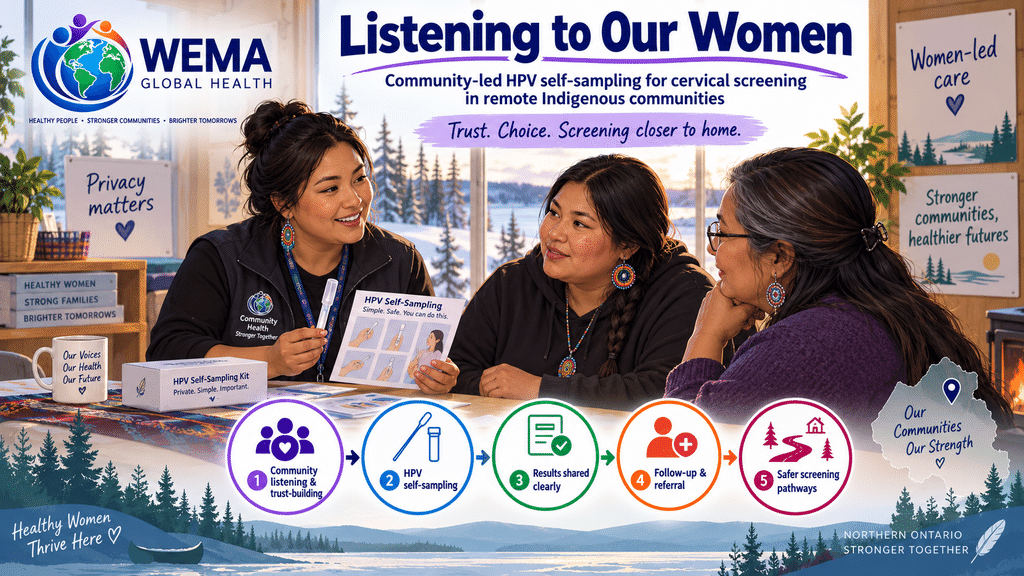
Listening to Our Women
Listening to Our Women brings cervical-cancer prevention into a community-grounded research process. Screening may appear universally available on paper while remaining difficult to use for women living far from conventional services. Geography matters, but so do trust, privacy, cultural safety, previous experiences of health care and confidence that a positive result will lead to understandable and respectful follow-up.
The project works with Indigenous women in remote Northern Ontario to understand how those realities shape participation in cervical screening and the potential role of HPV self-sampling. Self-sampling can create a different entry point because a woman does not necessarily have to begin with a pelvic examination in a distant clinic. The project does not assume that changing the collection method automatically solves access; communication, result handling and referral still determine whether prevention is complete.
Listening to Our Women therefore asks a broader service-design question: what would a cervical-screening pathway need to look like to be culturally safe, trustworthy and workable in remote First Nations communities? The research uses participatory approaches to understand barriers and enablers before finalizing strategies. Community priorities shape how self-sampling, communication and knowledge translation are considered, making lived experience part of the evidence base for future implementation.
Equity in this context means more than offering another screening technology; it means ensuring that the entire pathway can be trusted and completed.