
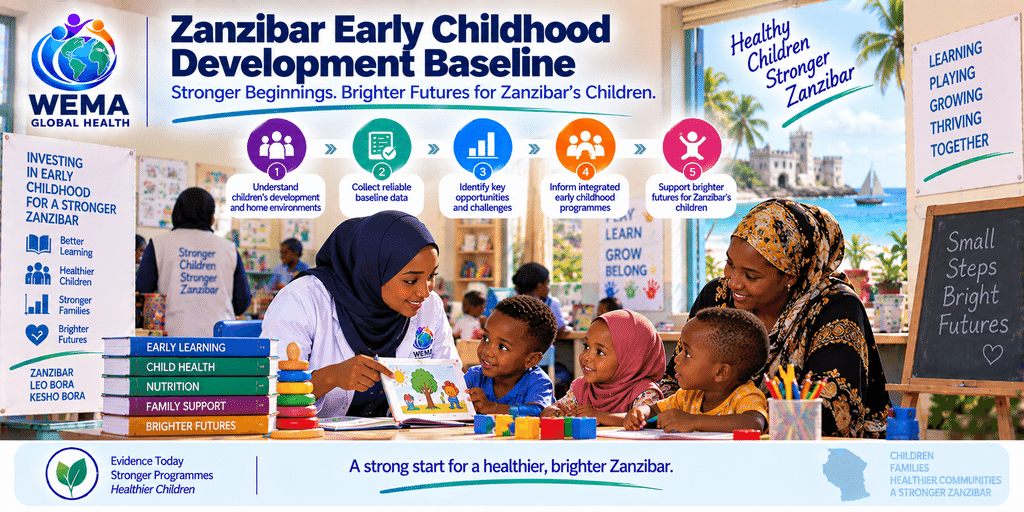
Zanzibar Early Childhood Development Baseline
The Zanzibar Early Childhood Development Baseline begins from a simple but consequential idea: readiness for school is shaped long before a child enters a classroom. Language, motor development, social-emotional growth and early learning develop within an environment of nutrition, health, responsive caregiving, safety, play, household resources and access to services. Understanding children's development therefore requires a picture that reaches beyond education alone.
The baseline was designed to create that shared picture across Zanzibar. It combined population measurement with qualitative inquiry and review of the policies and services surrounding families. By bringing children's developmental domains together with caregiving conditions and service environments, the study created an evidence foundation that different sectors could use to understand where opportunities are strong, where they are uneven and where closer coordination may be useful.
Later analysis of school readiness among children aged four to six years extended the baseline into a more focused population question. It showed how developmental measures can be examined alongside household and geographic circumstances without treating a single score as a fixed prediction of a child's future. The wider project therefore positions early childhood development as an ecosystem: children's opportunities emerge through interactions among families, communities, health and nutrition services, early learning, protection and public systems. Its value lies in making those relationships visible enough to support integrated planning and more precise future research.