
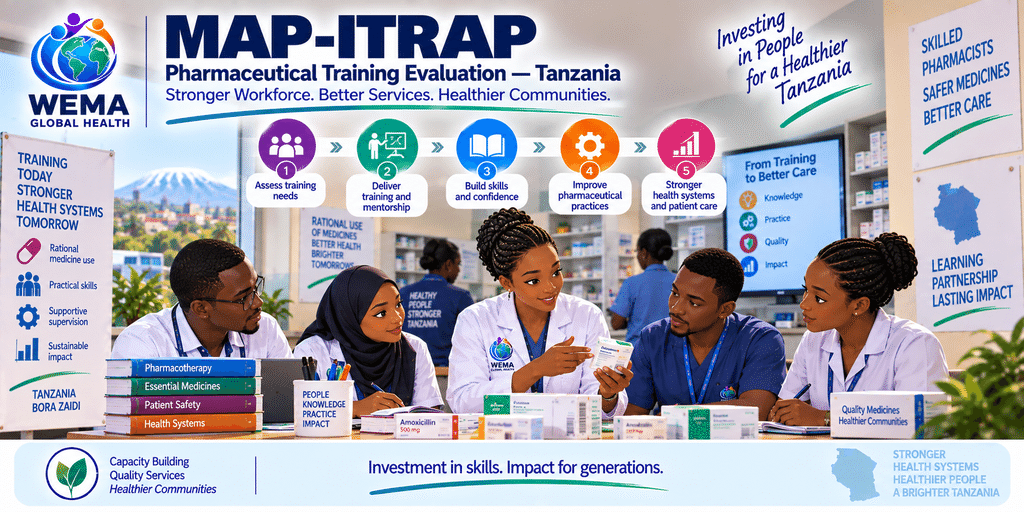
MAP-ITRAP Pharmaceutical Training Evaluation
Medicines access depends partly on the people who select, dispense, counsel and manage pharmaceutical services. A health system may have medicines on the shelf yet still struggle to deliver safe, reliable care when the pharmaceutical workforce is too small, unevenly trained or unsupported by strong institutions. MAP-ITRAP addressed that problem through a multi-actor partnership focused on improving non-academic pharmaceutical training in Tanzania.
The programme brought training institutions, regulators and other stakeholders into a shared improvement process around curriculum, tutor development and institutional resources. The evaluation asks a second-order question: did that partnership create changes that were relevant, coherent and capable of lasting beyond the initial project period? That shifts attention away from counting workshops, equipment or revised documents and toward the conditions under which workforce-development activities become institutional practice.
This makes MAP-ITRAP a programme-evaluation and systems-learning project. Its subject is pharmaceutical training, but its broader interest lies in how multiple organizations learn and change together. Curriculum reform may be valuable, yet it is difficult to sustain without capable tutors, regulatory alignment, stakeholder ownership and the infrastructure needed to teach and assess learners. The evaluation therefore examines the partnership as an ecosystem. It asks what changed, why change was plausible, how different actors contributed and what would allow gains to continue when external support changes. That perspective makes sustainability part of the evaluation from the beginning rather than an afterthought at programme closure.