
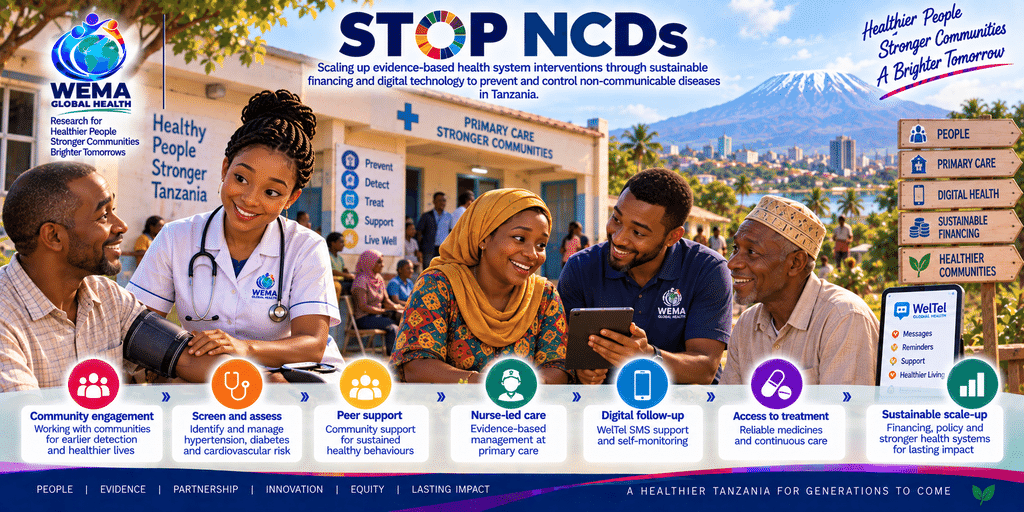
STOP-NCDs
STOP-NCDs addresses a basic contradiction in chronic-disease care: hypertension and diabetes require repeated contact over years, yet many health systems are still organized around episodic visits, limited specialist capacity, unstable medicine access and financing that can make continuity difficult. The programme asks what a sustainable primary-care model looks like when workforce, digital support, financing and patient engagement are treated as parts of one system.
The Tanzania programme combines evidence-based service redesign with sustainable financing approaches and digital tools for clinic management, patient communication and adherence support. Candidate components include nurse task-sharing, WelTel-supported communication, peer support and mechanisms intended to reduce financial barriers. STOP-NCDs uses an optimization strategy to determine which combination offers enough value to justify its complexity and cost before moving toward wider implementation.
Scale is part of the scientific question from the beginning. A small pilot can succeed because research staff manually solve problems; routine services must work through existing cadres, budgets, medicine supply and patient behaviour. STOP-NCDs therefore studies how intervention components fit into ordinary primary care and what is required for adoption, sustainability and expansion. The programme's broader purpose is to move NCD prevention and control away from isolated specialist encounters toward a connected chronic-care system in which detection, treatment, follow-up and financing reinforce one another over time.