
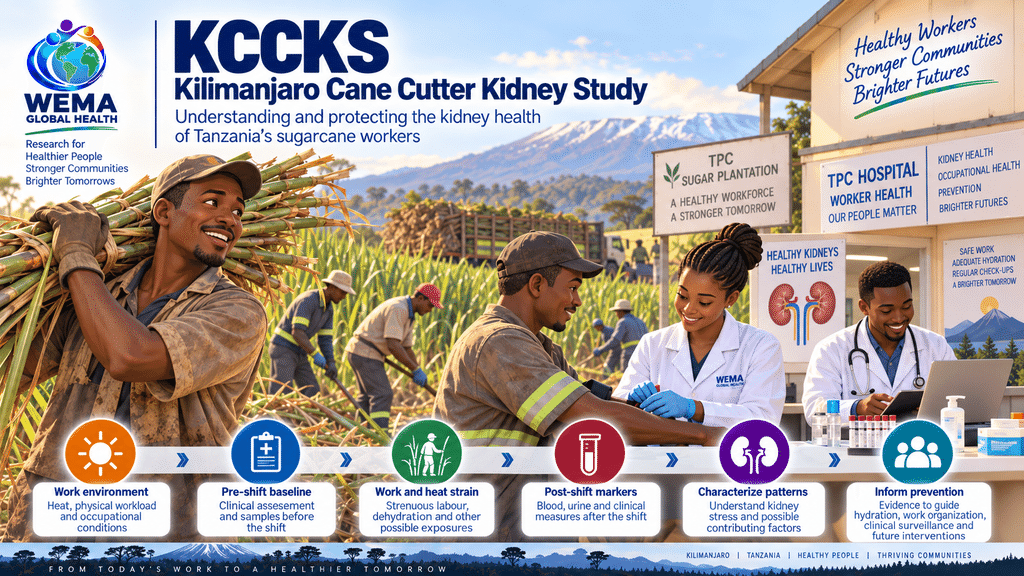
KCCKS / Kilimanjaro Cane Cutter Kidney Study
KCCKS brings a global kidney-health concern into a Tanzanian occupational setting. Chronic kidney disease of unknown cause has been reported among agricultural workers in several hot regions, where strenuous labour, heat exposure, dehydration and other workplace or environmental factors may overlap. Evidence from African cane-cutting populations has been much thinner, leaving uncertainty about whether similar kidney-stress patterns occur and what prevention should prioritize.
The Kilimanjaro Cane Cutter Kidney Study examines kidney health among sugarcane cutters working under heat and physical strain in northern Tanzania. Its purpose is not to begin with a single assumed cause. Instead, the project characterizes kidney function and acute physiological change while considering the wider exposure environment in which workers live and work. Heat, hydration, workload, medications, infections, metabolic risk and other possible contributors are treated as part of a complex occupational-health question.
That distinction matters because kidney injury can be silent. A worker may feel able to continue a shift while biological markers are changing, and a cross-sectional clinic assessment can miss changes that occur during the workday. KCCKS therefore studies workers close to the period of exposure and links clinical measurement with field conditions. The project creates a locally grounded evidence base for deciding which occupational protections and future causal questions deserve closer study.