
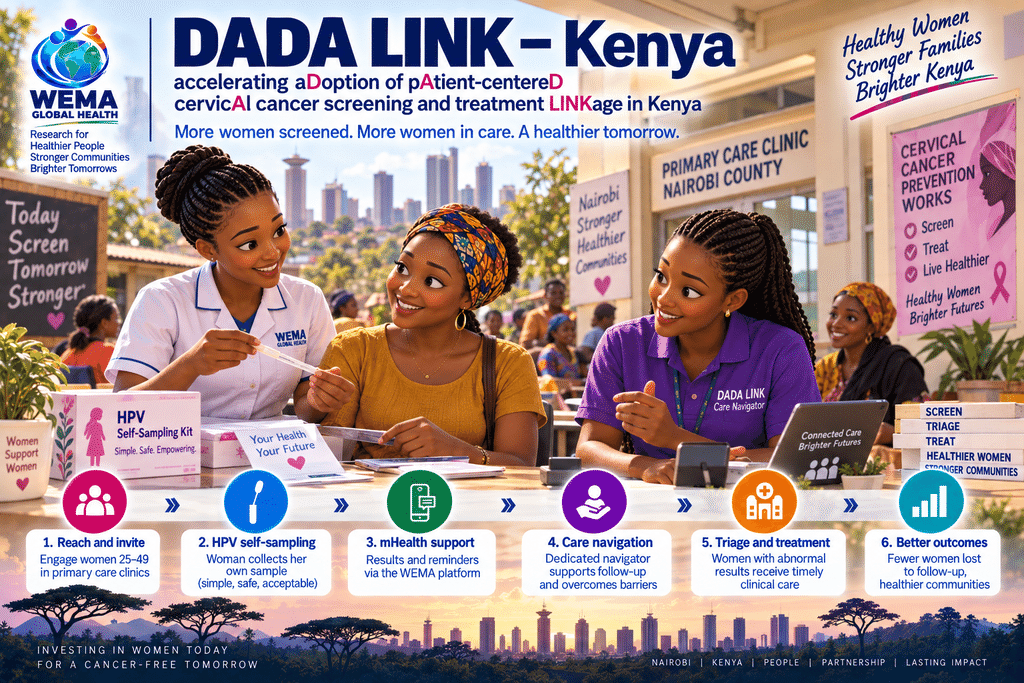
DADA LINK - Kenya
DADA LINK addresses the part of cervical-cancer prevention where many programmes lose women: after screening identifies risk but before diagnostic assessment or treatment is completed. The project begins from the principle that a screening programme is only as effective as its ability to carry women through the next necessary step. A positive result has little preventive value if the woman cannot understand it, reach triage or access treatment.
Based in Kenya and situated within the BREAKTHROUGH implementation-science environment, DADA LINK studies how HPV self-testing, care navigation and digital support can strengthen screening and treatment linkage in primary care. The intervention is deliberately multicomponent because loss to follow-up can arise from patient, provider and health-system barriers at the same time. Information may be delayed, referrals may be confusing, appointments may require travel and services may have no reliable way to know whether the next step was completed.
The project therefore treats continuity as the core outcome of implementation. HPV self-testing can make screening more accessible, but navigation and communication are needed to translate a result into action. The study also examines sustainability and cost so that a successful pathway does not depend indefinitely on project-specific resources. DADA LINK's wider purpose is to learn how cervical-cancer prevention can function as a connected cascade within Kenyan primary care: reach women, identify risk, support the next decision and reduce avoidable loss between screening and treatment.