
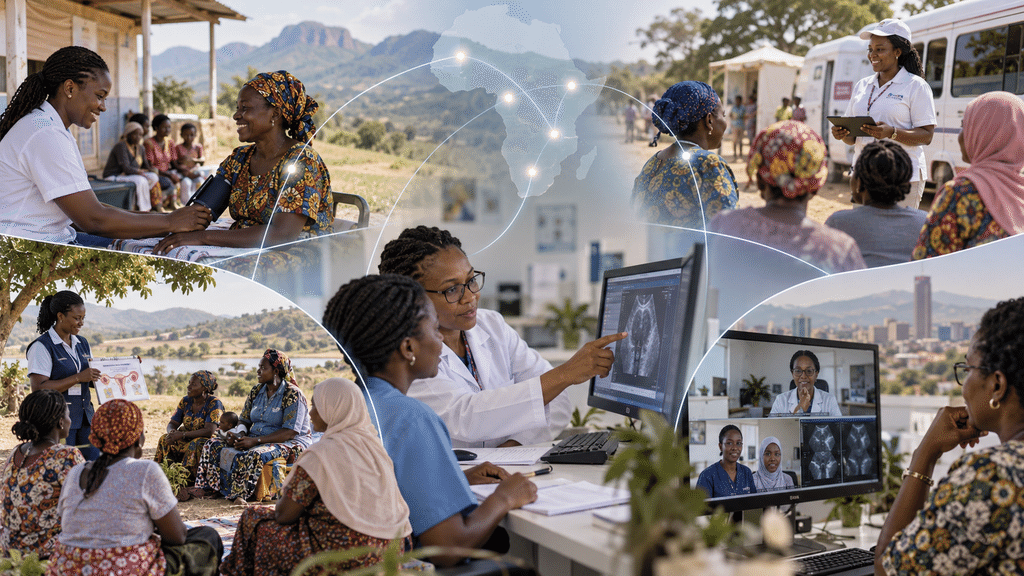
A new technology can remove an important barrier to cervical-cancer prevention without making a programme trustworthy, understandable or easy to use. A smartphone can strengthen clinical supervision. A text message can remind someone that screening exists. Self-sampling can reduce the need for a conventional pelvic examination. None of those tools, by itself, determines whether women feel comfortable entering care or whether a positive result leads to treatment.
A Tanzanian SMS and eVoucher trial showed that communication and practical support can change screening behaviour. Smartphone-enhanced visual inspection and SEVIA addressed a different problem: sustaining provider skill, remote review and quality assurance after women reached services. Later implementation evaluation asked whether patients, frontline providers, supervisors and programme actors found the system acceptable and workable. Participatory projects add another layer by asking communities to shape how interventions are introduced rather than receiving a finished design.
Taken together, these studies shift the question from “does the technology work?” to “what relationship does the technology enter?” Trust, community participation, workflow fit, connectivity, referral and treatment capacity determine whether a technically promising tool becomes useful care. The technology is one node in the system, not the hero of the story.
Publications behind this Insight
When Information and Transport Work Together: SMS, eVouchers and Screening Uptake
Erica Erwin, Kristan J Aronson, Andrew Day, Ophira Ginsburg, Godwin Macheku, Agnes Feksi, Olola Oneko, Jessica Sleeth, Best Magoma, Nicola West, Prisca Dominic Marandu, Karen Yeates. SMS behaviour change communication and eVoucher interventions to increase uptake of cervical cancer screening in the Kilimanjaro and Arusha regions of Tanzania: a randomised, double-blind, controlled trial of effectiveness. BMJ Innovations. 2019. DOI 10.1136/bmjinnov-2018-000276.
Open publicationFrom a Training Tool to a National Quality System: What SEVIA Learned at Scale
Karen Yeates, Erica Erwin, Zac Mtema, Frank Magoti, Simoni Nkumbugwa, Safina Yuma, Wilma M. Hopman, Alyssa Ferguson, Olola Oneko, Godwin Macheku, Agnes Feksi Mtei, Carter Smith, Linda Andrews, Nicola West, Milena Dalton, Ashley Newcomb, Ophira Ginsburg. Smartphone-Enhanced Training, QA, Monitoring, and Evaluation of a Platform for Secondary Prevention of Cervical Cancer: Opportunities and Challenges to Implementation in Tanzania. JCO Global Oncology. 2020. DOI 10.1200/go.20.00124.
Open publicationWhat People Said About SEVIA: Implementation Beyond Technical Performance
Alyssa L. Ferguson, Erica Erwin, Jessica Sleeth, Nicola Symonds, Sidonie Chard, Safina Yuma, Olola Oneko, Godwin Macheku, Linda Andrews, Nicola West, Melinda Chelva, Ophira Ginsburg, Karen Yeates. An Implementation Evaluation of the Smartphone-Enhanced Visual Inspection with Acetic Acid (SEVIA) Program for Cervical Cancer Prevention in Urban and Rural Tanzania. International Journal of Environmental Research and Public Health. 2024. DOI 10.3390/ijerph21070878.
Open publicationEvidence behind this Insight
- 1. Erwin E, et al. SMS/eVoucher cervical-screening trial. BMJ Innovations. 2019. DOI 10.1136/bmjinnov-2018-000276. When Information and Transport Work Together: SMS, eVouchers and Screening Uptake
- 2. Yeates K, et al. Smartphone-enhanced cervical screening training and quality assurance. JCO Global Oncology. 2020. DOI 10.1200/GO.20.00124. From a Training Tool to a National Quality System: What SEVIA Learned at Scale
- 3. Ferguson AL, et al. SEVIA implementation evaluation. 2024. DOI 10.3390/ijerph21070878. What People Said About SEVIA: Implementation Beyond Technical Performance