
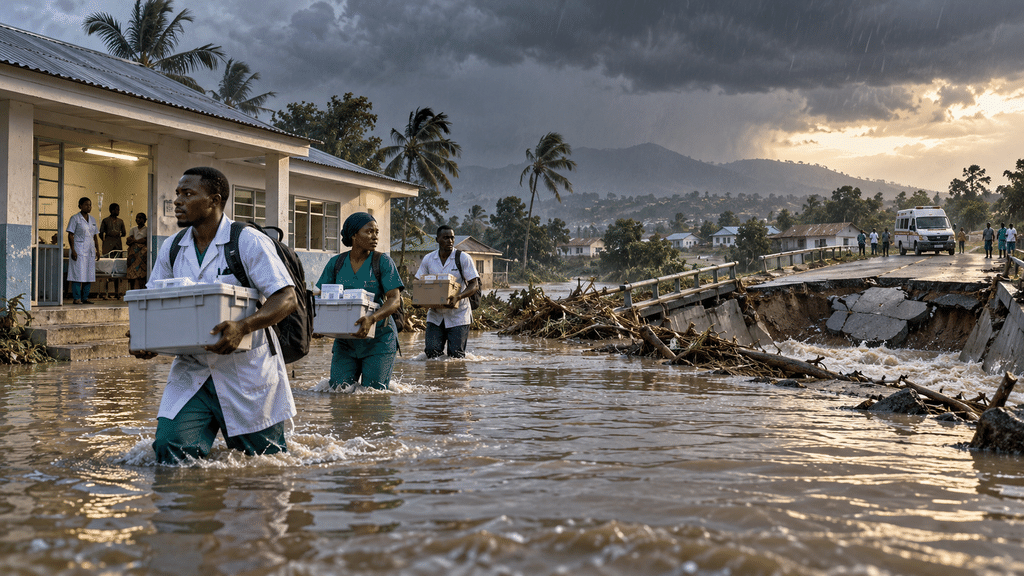
The HIV care cascade is usually presented as testing, linkage, treatment, retention and viral suppression. Climate change complicates that picture because every step depends on systems outside the clinic: roads, household resources, supply chains, stable livelihoods and functioning health infrastructure.
Systematic evidence from sub-Saharan Africa describes several plausible pathways through which drought, floods, extreme heat, food insecurity, migration and infrastructure disruption may affect HIV prevention and care. A 2026 study among older adults in Moshi adds direct empirical evidence on vulnerability: extreme-weather exposure, mobility and resource insecurity were associated with measures such as condom-use self-efficacy, relationship power and lifetime IPV. Those associations do not prove that climate events cause HIV infection, but they make the social pathway measurable.
This is why climate-HIV research needs to move beyond correlating weather with outcomes. The implementation question is continuity: what happens to clinic attendance, medication access, prevention behaviour, mobility and household stability during shocks, and which adaptive strategies preserve care?
Publications behind this Insight
When Extreme Weather Becomes an HIV Vulnerability
When Extreme Weather Becomes an HIV Vulnerability. 2026. 10.1177/09564624261446403.
Open publicationEvidence behind this Insight
- 1. Iwuji C, et al. Climate change and HIV outcomes/care in sub-Saharan Africa. Lancet HIV. 2024. DOI 10.1016/S2352-3018(24)00186-3. External evidence
- 2. Logie CH, et al. Extreme weather, mobility, resource insecurity and HIV vulnerabilities in Moshi. 2026. DOI 10.1177/09564624261446403. When Extreme Weather Becomes an HIV Vulnerability